02 / Projects

Examples of what I have built.

Every one of these started as somebody’s problem. What follows is the brief, what went into the build, and what came out the other side.

All of it is built to solve a problem, and built to be tested and iterated on.

01 / CTO & co-founder, 2024-26

Suffrago

Co-founded and built end-to-end: a civic reasoning platform that turns fragmented public data into evidence MPs, NGOs and journalists can act on. I owned the technology from the first line of code to the global launch.
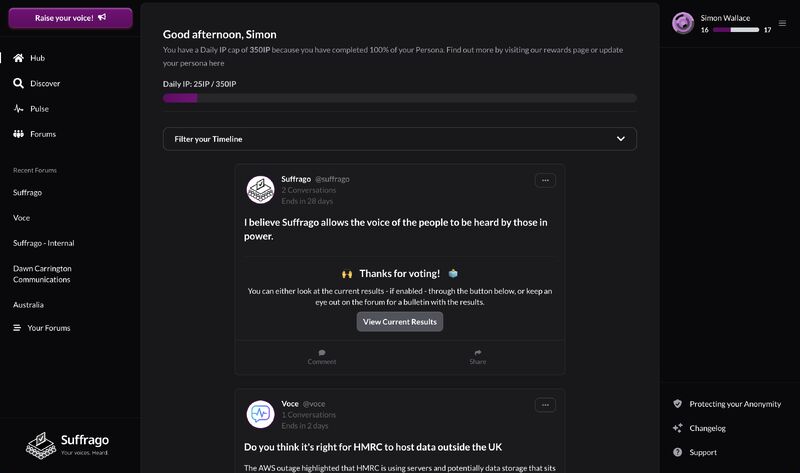
Solo-built the MVP in three months, then shipped four major versions including a global launch inside a year.
Built agentic AI systems and contextual retrieval pipelines across millions of documents.
Created large-scale geospatial clustering models over UK population and sentiment data.
Delivered data-backed reports for MPs, NGOs, corporates and global organisations.
Represented Suffrago before a UK House of Commons select committee.
Led cloud infrastructure, security, CI/CD and observability, plus product and investor strategy.
Agentic AIContextual retrievalGeospatial modellingAWSNode.jsPostgreSQL
The Suffrago platform hub, showing a live conversation timelinePreview
Published from the platform
Estimating probable suicides by constituencyCivic insight report, Sept 2025
No homes, no progress: the UK’s infrastructure problemCivic insight report, July 2025
Inheritance tax impact by districtCommissioned by a national newspaper, Feb 2025
02 / Demonstrandum joint venture, brief to live in two weeks

Neon Routes

A Demonstrandum joint venture that builds, creates and manages lead generation pipelines end to end. Tracking, generative creative, experimentation, compliance and analytics sit inside one application called Compass, instead of five stitched-together tools, and the whole thing is driven from its own MCP layer. neonroutes.com is itself built and run on the platform, live tests included.
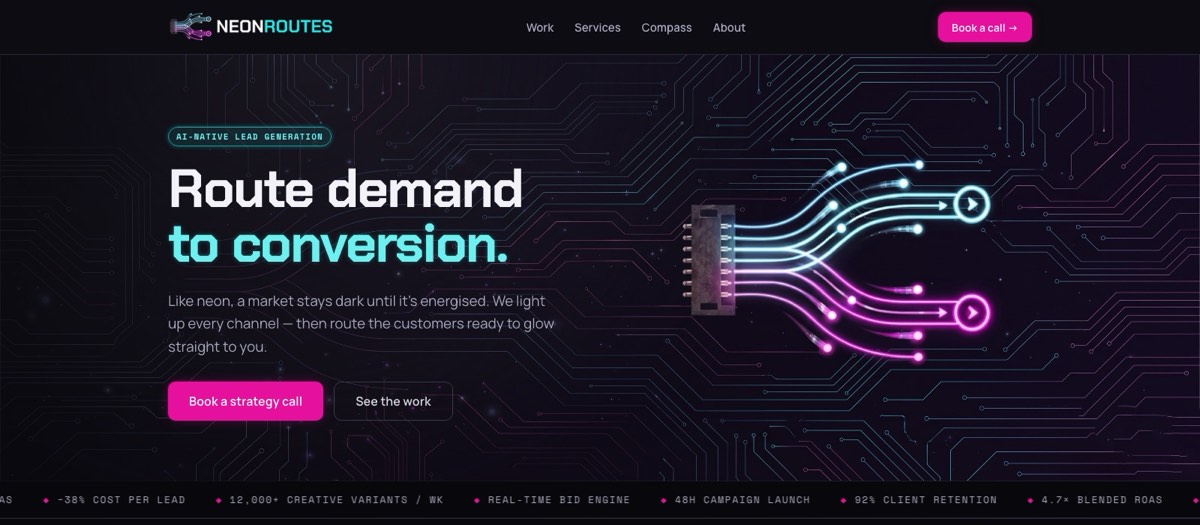
Built an MCP that generates landing pages, sets up the initial experiments and manages the application flow directly from there.
A/B testing is built into every rendered application: it selects its own significance level and closes the test automatically once significance is reached.
Generative AI creative identifies the best method of communication for each audience.
A compliance framework ships with every page we deploy, so anything compliance-related is tracked and monitored by default.
One database behind every application, feeding customisable conversion and monitoring dashboards with per-user access.
GDPR- and privacy-compliant analytics, with GTM and Facebook click IDs tracked and logged automatically.
Full media buying analytics with automated reporting, so spend and performance land in the same place as the conversion data.
A branding platform that generates presentations and decks automatically through the same MCP.
Generative AIMCPExperimentationLead generationMedia buyingGDPRAnalytics
The Neon Routes site, an AI-native lead generation platform that is itself built on the platformPreview
Outcomes so far
2 weeksFrom initial brief to live and tested.
-38% CPLReduction in cost per lead across client deployments.
6 pagesGenerated for a client inside a single week.
03 / Demonstrandum, built once and delivered into client work

Auth Template

Generative AI coding is only as good as the codebase it is working in: give it a good one and it does better work. Auth Template is the answer to the eight to ten weeks we kept spending on the same backbone: authentication, admin, notifications, profile and settings management. That is also where generated code is weakest and most likely to carry a security hole. It gets an engagement to a proof of concept that looks and behaves like a real application instead of an interactive slideshow, on a foundation solid enough to grow a product on.
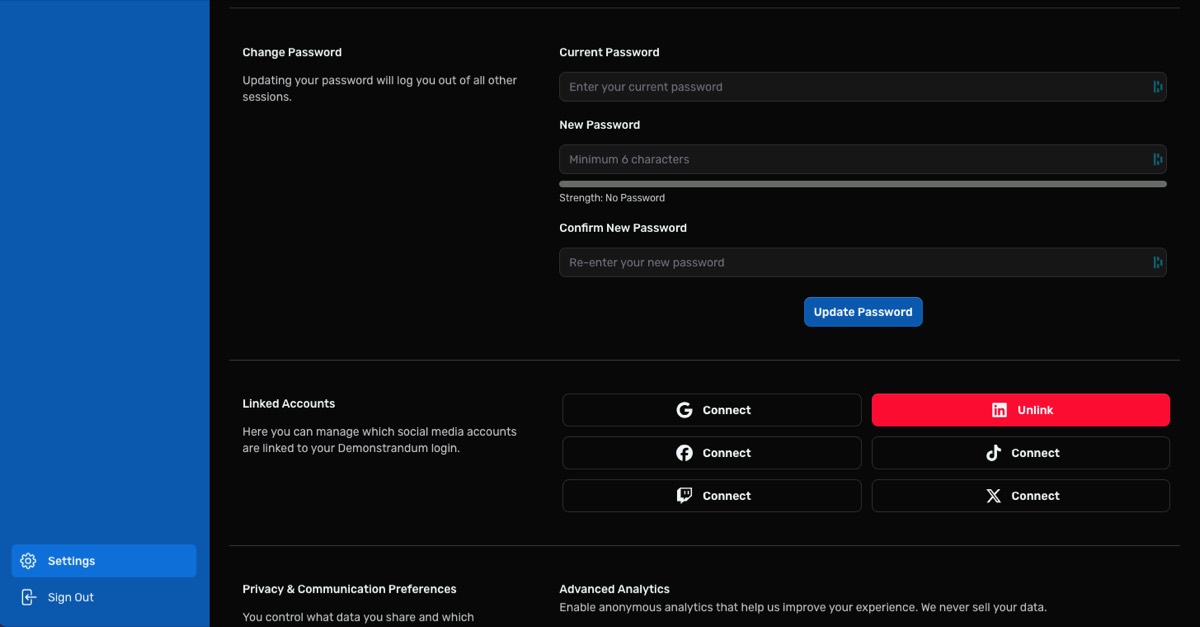
Removes the eight to ten weeks otherwise spent rebuilding authentication, admin, notifications and profile/settings management on every engagement.
Hardens the security-sensitive backbone up front, covering sessions, invitations, policy gates, forced password resets, bans and terminations, so generated code sits on something already reviewed.
Ships with a working admin hub, analytics dashboards and a notification system, so what clients test is the real thing.
A pseudo multi-tenant variant, built from the ground up, covers organisation-level sign-in with user management, administration and both brand and individual profiles, so a client needing many organisations switches template instead of starting again.
Secrets managed through Doppler, with encryption keys designed for rotation from the outset.
Built for scale and repeatability: the same foundation drops into each new client build.
Augments generative AI instead of depending on it, because the quality of the codebase sets the quality of what comes out of it.
AuthenticationSecurityMulti-tenancyNext.jsPrismaPostgreSQLScalability
The Auth Template account console, with password management, linked accounts and privacy controls all built out rather than stubbedPreview
Outcomes so far
8 to 10 weeksOf repeated backbone build removed from every project.
6 weeksFrom a standing start to a client's first launched product.
2 weeksFrom the template launching to its first client deployment.
04 / Demonstrandum, brand hub

Deck Builder

Part of Demonstrandum's brand hub: every slide is a predefined JSON structure, so a deck can be assembled by hand in the app or generated end to end through MCP. It sits inside the principle the consultancy runs on: automate the consistent, repeated work, and leave people free to do what only people do well.
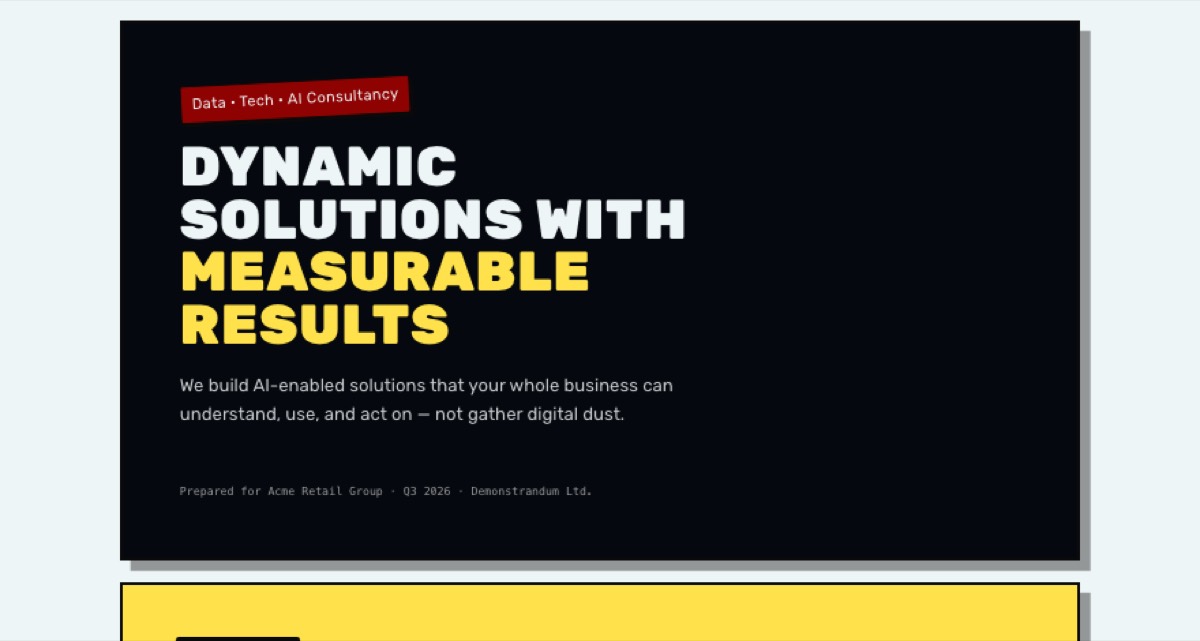
Every slide is a predefined JSON structure covering title, agenda, metrics, funnels, bar, line, pie and scatter charts, timelines, comparisons, quotes and closing, so an agent can author a whole deck through MCP and the app renders it on brand.
The structures mirror the shapes a data science team already works in, which is exactly why the MCP can read them and generate a full deck in one pass.
Charts are part of the brand: a graph built by a data scientist and one built by someone in a non-technical division come out looking like they belong to the same house.
A deck that would take two or three days to draft arrives in under ten minutes, at first-iteration quality.
The time saved goes on refinement and the argument instead of working out where to start.
Completely brandable: colour, type and components come from the design system, so anyone produces on-brand output without a designer in the loop.
User-accessible instead of developer-only: the team builds, saves and shares decks in the app.
Exports to native PowerPoint and PDF, so a deck carries on in PowerPoint or Google Slides.
MCPDesign systemsNext.jsPostgreSQLPowerPoint exportAutomation
A generated Demonstrandum pitch deck slide, rendered from its JSON structurePreview
Outcomes so far
Under 10 minFor a deck that previously took two to three days.
Self-serveAnyone can produce a high-quality, on-brand deck.
PPTX + PDFExports open in PowerPoint or Google Slides.
Next step

Tell me what isn’t shipping yet.

I work with organisations I know my skillset can help. If I can’t, I will say so, and I probably know someone in my network who can. I won’t waste your time.

One hour. Bring the problem. Leave with answers.

Start the conversation →